
Mini-split systems have earned a reputation for being one of the most dependable HVAC options on the market. Their engineering is straightforward, their components are proven, and when installed correctly, they deliver years of quiet, efficient comfort with minimal maintenance. But the key phrase there is "when installed correctly."
This article breaks down what makes mini-splits inherently reliable — and why the quality of the installation is the single biggest factor in whether your system lives up to that potential.
Part A: Why Mini-Splits Are Inherently Reliable
Unlike traditional HVAC systems that rely on extensive ductwork and complex multi-component assemblies, mini-splits are engineered for simplicity and durability. Here's why they consistently outperform expectations.
1. Simple Design, Fewer Moving Parts
A mini-split system consists of just two main components: an outdoor condenser/compressor unit and one or more indoor air handlers, connected by refrigerant lines and control wiring. There are no ducts to leak, no complex damper systems, and no blower compartments buried inside your walls.
Fewer moving parts means fewer things that can break. The simplicity of the design is one of the primary reasons mini-splits have such strong reliability records across manufacturers.
2. Robust Inverter Technology
Most modern mini-splits use inverter-driven compressors. Unlike traditional single-stage compressors that cycle on and off at full power, inverter compressors continuously adjust their speed to match the cooling or heating demand.
This means less mechanical stress on the compressor, smoother operation, and significantly reduced wear over time. The compressor — the most expensive component in any HVAC system — runs at a gentle cruise instead of constantly sprinting and stopping.
Why Inverter Tech Matters
- ✓Eliminates the hard start/stop cycling that wears out compressors
- ✓Maintains more consistent temperatures with less energy
- ✓Reduces electrical stress on capacitors and contactors
3. Individual Zone Control
Each indoor unit in a mini-split system operates independently. That means you're only conditioning the rooms you're actually using — no wasted energy pushing air through empty bedrooms or hallways.
From a reliability standpoint, zone control also means that if one indoor unit needs service, the rest of the system continues operating normally. You never lose all heating or cooling at once, which is a significant advantage over traditional central systems.
4. High-Quality Components
Leading mini-split manufacturers use high-grade copper refrigerant lines, corrosion-resistant coil coatings, and electronically commutated motors (ECMs) that are built to last. The indoor units have washable filters, self-cleaning modes, and sealed electronics designed to handle humidity and temperature extremes.
When you pair quality components with a simple, proven design, you get a system that can deliver 15–20+ years of reliable service with basic annual maintenance.
Part B: The Critical Role of Correct Installation
Here's the reality: even the best mini-split system in the world will underperform, leak refrigerant, or fail prematurely if it's not installed correctly. The equipment is reliable — but only if the installation meets the standards the manufacturer engineered it for.
These are the installation practices that separate a system that lasts 20 years from one that starts having problems in year two.
1. Proper Sizing
An oversized mini-split short-cycles — it cools the room too quickly, shuts off, then kicks back on repeatedly. This puts unnecessary stress on the compressor and fails to properly dehumidify the space. An undersized unit runs constantly, can't keep up with demand, and wears out faster.
Correct sizing requires a proper load calculation based on room dimensions, insulation, window exposure, ceiling height, and local climate data — not guesswork or rules of thumb.
2. Optimal Placement
Where the indoor and outdoor units are mounted directly affects performance and longevity. The indoor unit needs adequate clearance for airflow, should be positioned away from heat sources, and mounted at the correct height for efficient air distribution.
The outdoor unit needs proper clearance from walls and obstructions, adequate airflow around the condenser coils, and protection from direct debris exposure. Poor placement leads to restricted airflow, higher operating pressures, and premature component wear.
3. Leak-Free Connections
Every flare fitting and braze joint in the refrigerant line set is a potential leak point. Even a microscopic leak will slowly bleed refrigerant over months, causing the system to lose efficiency, ice up, and eventually damage the compressor.
Proper flare connections require calibrated torque wrenches, correct flaring tools, and careful technique. Brazed joints need proper nitrogen purge during the brazing process to prevent internal oxidation. There are no shortcuts here — a single bad connection can compromise the entire system.
4. Pressure Testing
Before any refrigerant is released into the line set, the system must be pressure tested with dry nitrogen to verify there are no leaks. This means pressurizing the lines to the manufacturer's specified test pressure and holding it for a sufficient period to confirm zero pressure drop.
Skipping this step — or rushing through it — means you won't catch a slow leak until the system starts underperforming weeks or months later. By then, the refrigerant has been leaking into the atmosphere and the compressor has been running with an incorrect charge.
5. Secure Mounting, Drainage, and Correct Electrical Wiring
The indoor unit must be mounted securely to wall studs or a proper mounting plate — not just drywall anchors. A poorly mounted unit vibrates, develops noise issues, and can eventually loosen or shift, stressing the refrigerant connections.
The condensate drain line must be properly pitched to prevent water backup. Standing water in the drain pan leads to mold growth, musty odors, and potential water damage to walls and ceilings.
Electrical wiring must be correctly sized for the unit's amperage draw, properly routed, and connected to a dedicated circuit with the correct breaker size. Incorrect wiring can cause nuisance tripping, voltage drops, or in worst-case scenarios, fire hazards.
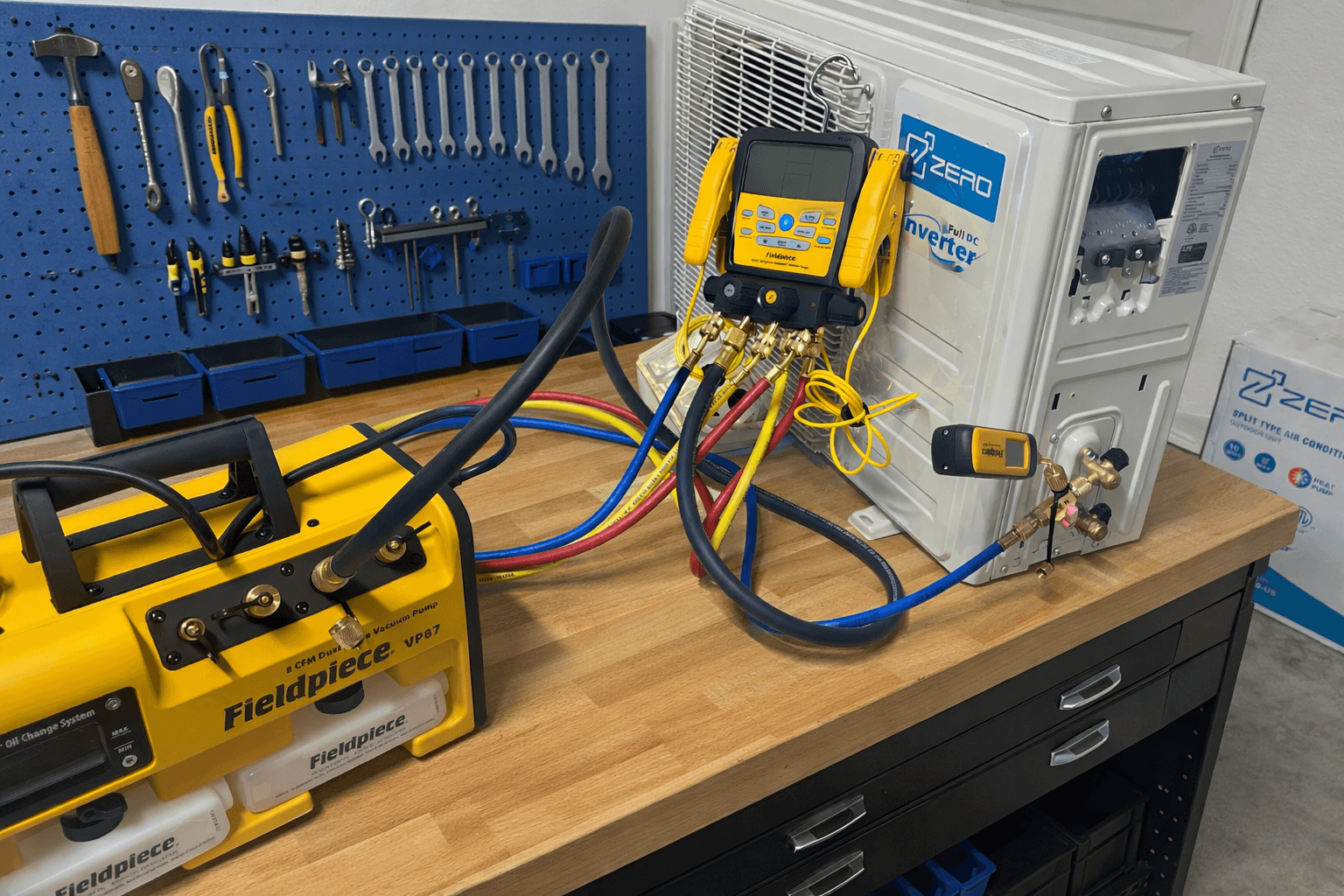
6. Pull a Deep Vacuum Below 500 Microns — and Hold for 60 Minutes
This is arguably the most critical step in any mini-split installation, and the one most often rushed or skipped by inexperienced installers.
Before releasing the factory refrigerant charge, the line set and indoor unit must be evacuated to remove all air and moisture. The target is a vacuum level below 500 microns, held for a minimum of 60 minutes to verify the system holds vacuum and is completely sealed.
Why 500 Microns Matters
- ✓Moisture left in the system mixes with refrigerant to form acids that corrode copper lines and compressor windings
- ✓Trapped air creates non-condensable gases that raise system pressures and reduce efficiency
- ✓A vacuum that won't hold below 500 microns indicates a leak that must be found and fixed before proceeding
- ✓The 60-minute hold time verifies the system is truly sealed — not just temporarily holding pressure
An installer who skips the vacuum process or pulls down to only 1,000–2,000 microns is leaving moisture and contaminants inside the system. The unit may cool fine for a few months, but the long-term damage to the compressor and internal components is already underway.
The Bottom Line
Mini-split systems are engineered to be simple, efficient, and durable. The technology is proven, the components are high-quality, and the design eliminates many of the common failure points found in traditional HVAC systems.
But none of that matters if the installation is done wrong. Proper sizing, leak-free connections, correct electrical work, and a verified deep vacuum are what separate a system that lasts two decades from one that starts failing in two years.
At Vargas HVAC, every mini-split installation follows manufacturer specifications to the letter — including pressure testing, deep vacuum to below 500 microns with a 60-minute hold, and documented verification. Contact us for a free consultation.
Get a Free Quote