
What is that "VFD" You Keep Hearing About in New Equipment?
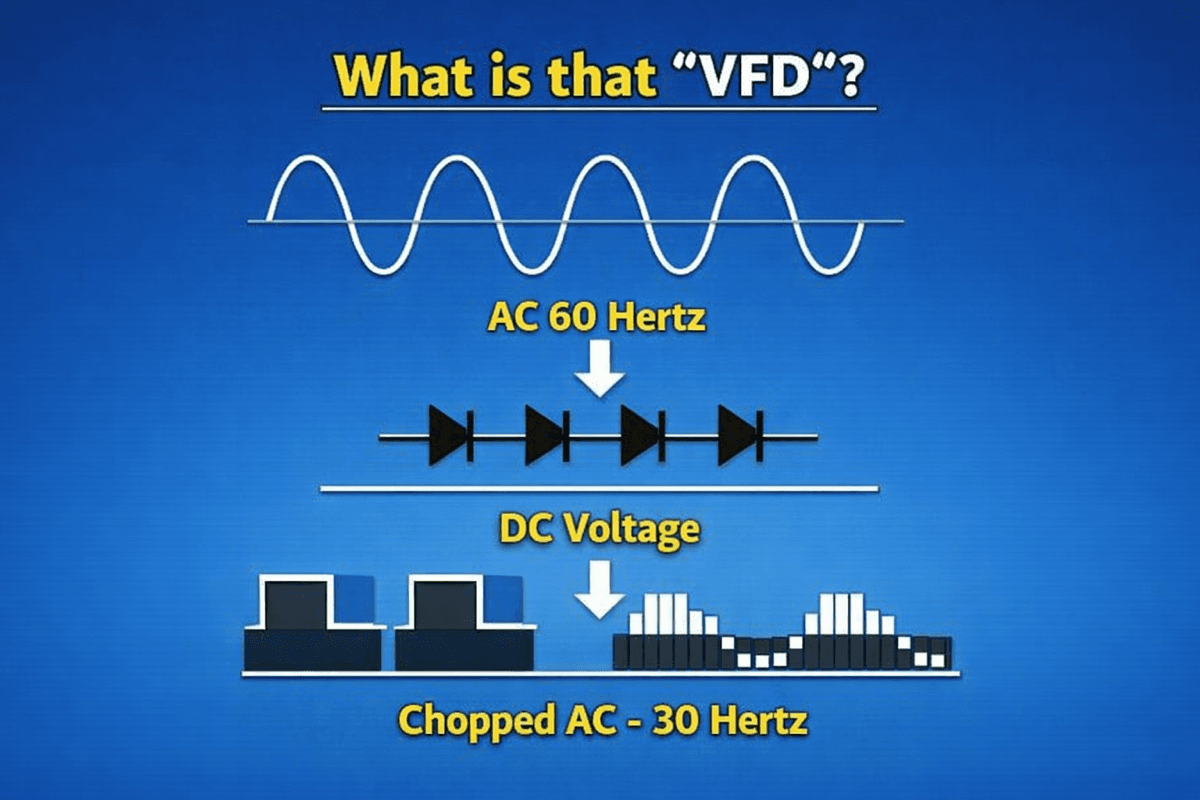
You might have heard the term VFD (Variable Frequency Drive) or "Inverter" when looking at modern HVAC equipment. But what does it actually do, and why does it matter for your comfort and energy bills?
The Basics: How Motors Usually Run
To understand VFDs, we first need to look at standard electricity. In the US, our electricity runs at 60 Hertz (Hz). This means the electrical current alternates (switches direction) 60 times per second.
For a standard AC motor, this frequency directly dictates speed. Because the current has 60 waves per second, the motor is locked into spinning at a speed that matches that frequency (typically 60 revolutions per second, or 3,600 RPM, minus some "slip").
Think of it like a light switch: A standard motor is either 100% ON (full speed) or OFF. There is no middle ground.
How a VFD Changes the Game
A Variable Frequency Drive (VFD) allows the motor to run at any speed, not just full blast. It achieves this through a clever three-step process:
- Convert AC to DC:
First, the drive takes the standard wavy AC current and runs it through a rectifier. This converts it into DC (Direct Current), which looks like a flat, straight line of voltage. - Smooth the Signal:
Capacitors smooth out this DC voltage to create a stable power supply. - Invert Back to AC (The Magic Step):
Finally, an inverter "chops" this straight DC line up to imitate an AC wave. But here's the trick: it controls how many waves it creates.
Why This Matters
By controlling the number of "chopped" waves, the VFD can create any frequency it wants.
- If it generates 60 waves per second, the motor runs at full speed.
- If it generates 30 waves per second, the motor runs at half speed.
- It can ramp up slowly, run at 10% speed, or hold steady at 50%—whatever the system needs.
The Real-World Benefit
Imagine driving a car where the gas pedal only had two positions: floor it or let go. That's a standard HVAC system. A VFD gives your system a working gas pedal, allowing it to cruise efficiently, reduce wear and tear, and maintain a perfectly steady temperature in your home.